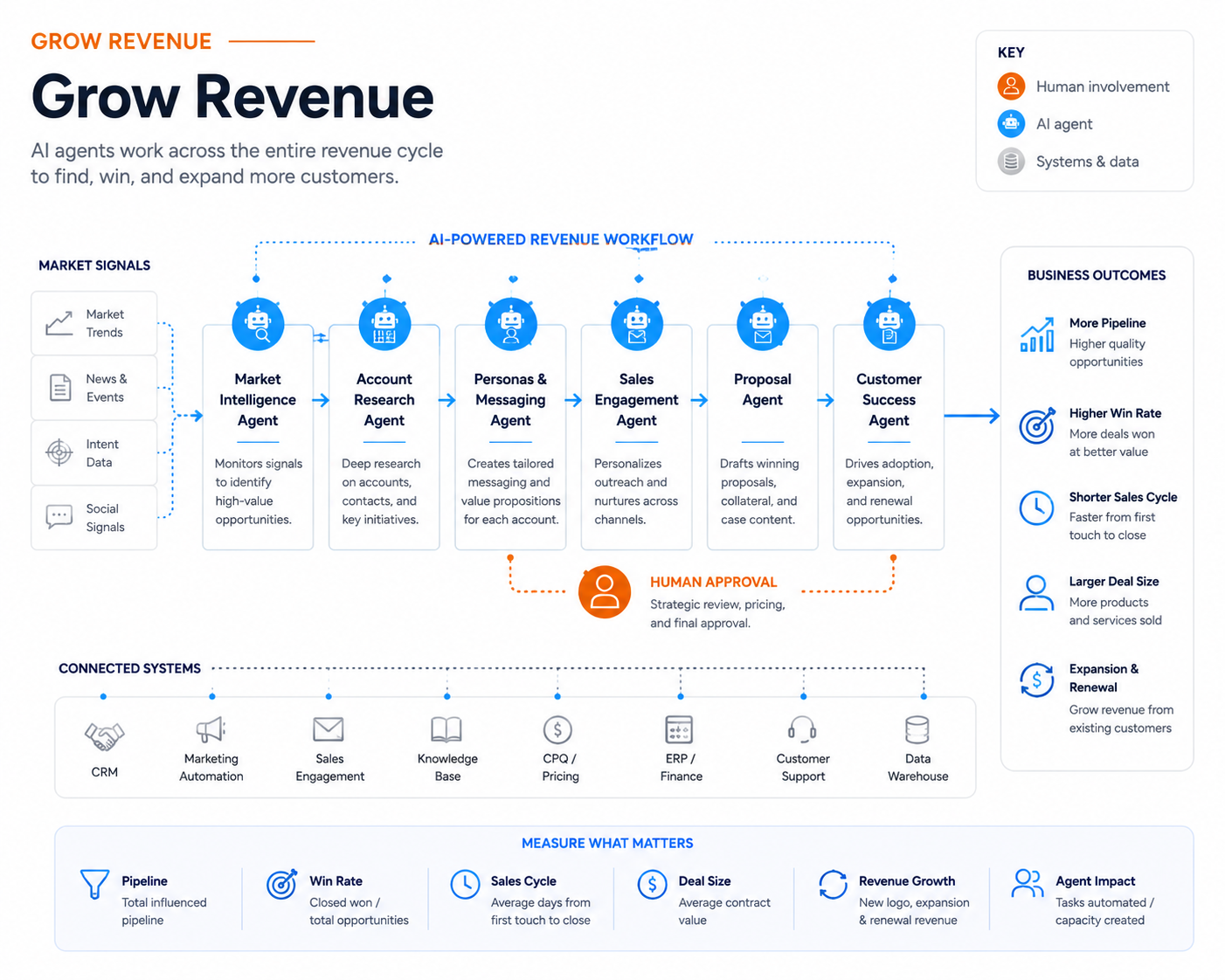
Illustrative workflow, not client data
Agentic AI is not a department. It is a way to redesign how revenue is generated, how work is delivered and how decisions move through the company.
The strongest opportunity is rarely the task that is easiest to automate. It is the workflow where a better operating design creates meaningful economic value.
Three business outcomes, each with an illustrative agent workflow.
A signal starts the chain. Five agents build the pitch. A person approves it before it reaches the CRM.
Every input type routes through the same five-agent line. Whatever an agent can't resolve on its own escalates to a person, instead of shipping wrong.
Same seven steps, done by four agents at once instead of one person in sequence. Cycle time compresses; a person still makes the final call.
| Revenue | Margin and capacity | Speed and delivery |
|---|---|---|
| Account research | Customer support | Customer onboarding |
| Lead qualification | Finance and reporting | Research and analysis |
| Sales personalization | Document processing | Product development |
| Proposal creation | Internal knowledge | Campaign production |
| Pipeline intelligence | Procurement | Approvals and routing |
| Customer expansion | Quality assurance | Executive reporting |
Agentized redesigns revenue workflows so agents can research, qualify, personalize, assemble and monitor at machine speed while people retain control of judgment, relationships, pricing and exceptions.
Request a Revenue Workflow BriefingAccount intelligence, lead qualification, sales personalization, proposal production, pipeline intelligence, customer expansion, retention and market monitoring.
Illustrative workflow, not client data
A sales representative should not spend hours assembling account context, searching internal knowledge, rebuilding a standard proposal or chasing routine follow-up. Agents can prepare the work. People decide how to use it.
What we measureQualified pipeline, conversion, sales cycle, proposal cycle time, win rate, expansion, retention, representative capacity and cost of acquisition.
Agentized redesigns repeatable knowledge work so agents can classify, retrieve, draft, reconcile, route and monitor while people handle judgment, complex exceptions and accountability.
Request an Operations Workflow BriefingCustomer support, finance, reporting, document processing, internal knowledge, procurement, human resources, quality assurance and repetitive service delivery.
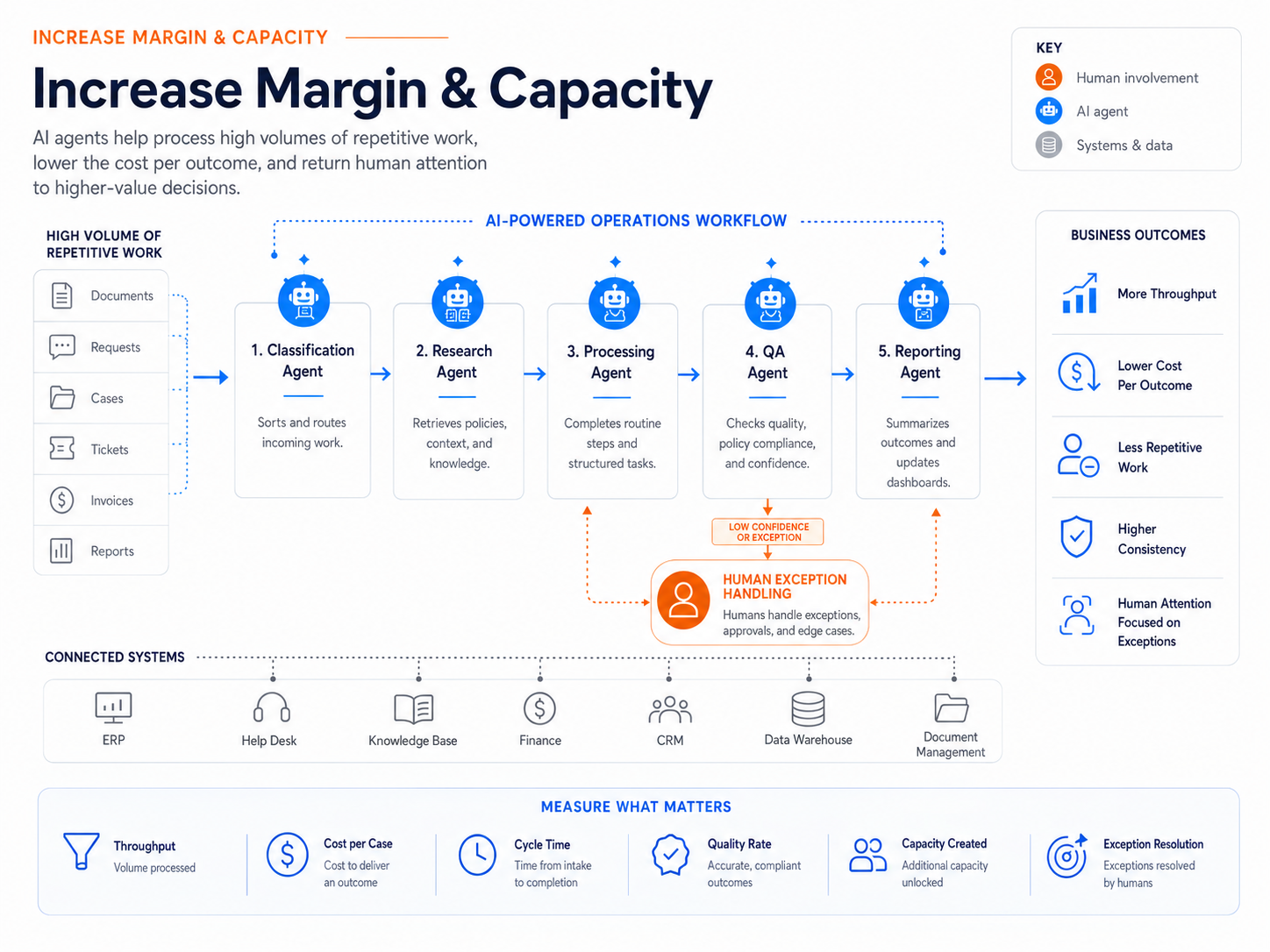
Illustrative workflow, not client data
Saved hours create value only when the company uses them to serve more customers, improve quality, shorten response time, reduce overtime or complete work that was previously left undone.
What we measureCost per case, throughput, backlog, response time, error rate, rework, overtime, service level, employee time returned and realized financial impact.
Agentized redesigns workflows where coordination, research, approvals and handoffs create more delay than the work itself.
Request an Execution Workflow BriefingCustomer onboarding, product development, market research, campaign production, executive reporting, project delivery, approvals, competitive monitoring and decision support.
Agents can maintain context across systems, prepare the next action, identify missing inputs, route approvals and surface exceptions. People set priorities, make consequential decisions and resolve ambiguity.
What we measureCycle time, time to decision, time to launch, time to quote, onboarding duration, approval latency, delivery predictability and right-first-time quality.
An Agentic Value Assessment identifies and prioritizes the workflows with the strongest economic case.