Agentic business transformation

Turn the AI mandate into an operating result.

Agentized combines strategy, workflow redesign, implementation, governance and change management to move agentic systems from executive priority to production.

Most AI programs do not fail because the model is weak.

They stall because the company selected a low-value task, preserved a broken workflow, ignored integration, never established a financial baseline, failed to assign an owner or treated governance and adoption as work to complete later.

Agentized designs the operating system around the technology, not the technology in isolation.

How we measure value

Every engagement is measured against six questions.

  1. Did it generate or protect revenue?
  2. Did it reduce the cost of producing the outcome?
  3. Did it increase throughput or capacity?
  4. Did it compress cycle time?
  5. Did it maintain or improve quality?
  6. Did employees and customers adopt it?

A favorable estimate becomes credible only when production results appear in operating measures and financial outcomes.

Guides and rankings

Choosing an AI consulting partner.

Who this is for

Built for mid-size companies with a material problem to solve.

Agentized was founded by Jas Dhillon and Mark Fidelman, authors of the upcoming book AGENT SHOCK: Surviving and Profiting from the Rise of AI Agents and Robots. The book lays out the thinking behind how we work, and you can read the introduction now.

The Agentized Value System

Five steps from a business opportunity to an agent running in production.

01

Diagnose

Map the value chain, systems, data, bottlenecks and economics.

02

Redesign

Rebuild the priority workflow around human judgment, agent execution and explicit decision rights.

03

Deploy

Build, configure, integrate, evaluate and launch agents in a controlled production environment.

04

Prove

Measure the result against the baseline, including operating and technology costs.

05

Scale

Expand what works and establish the governance and operating model required for continued adoption.

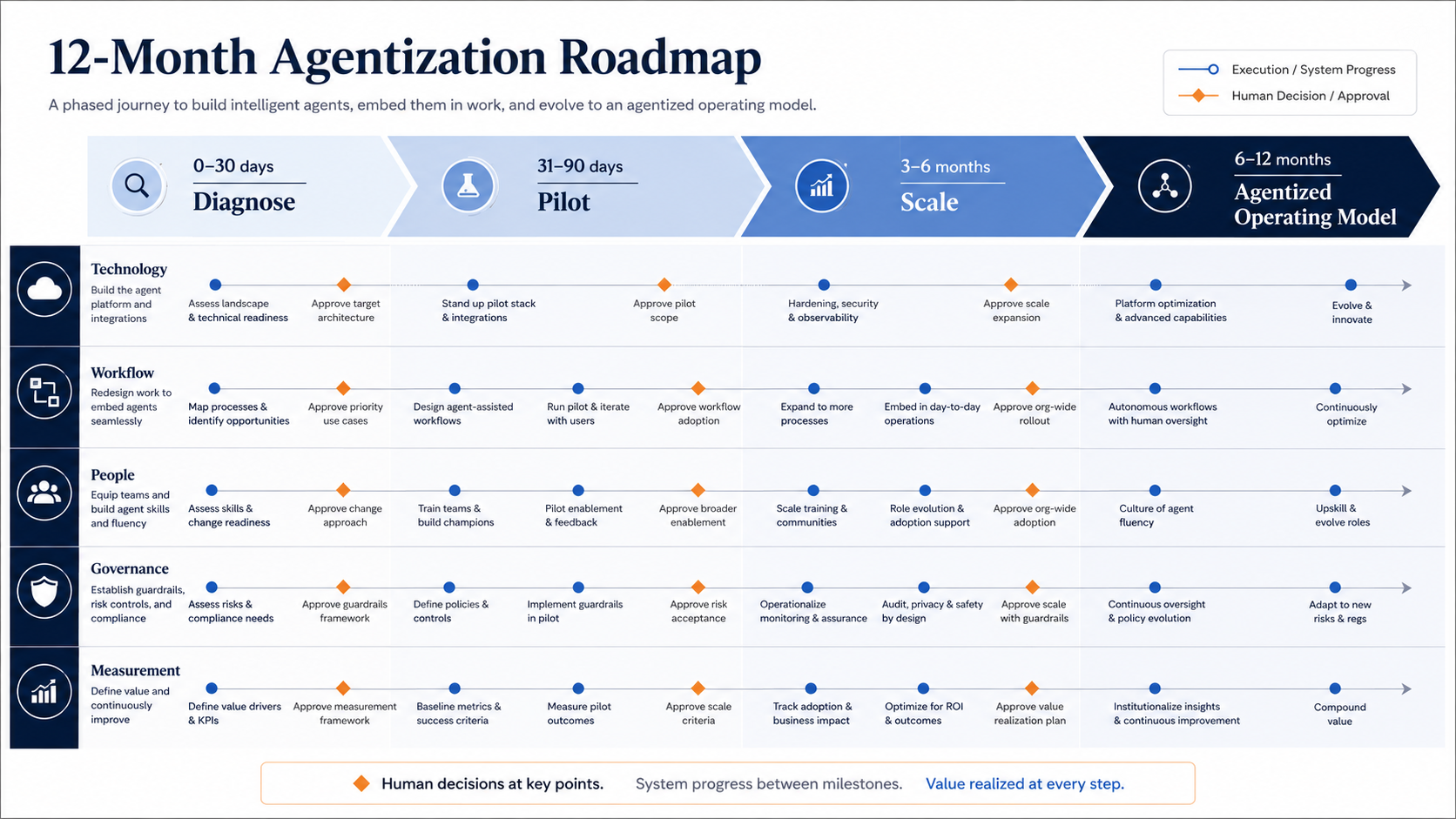
A 12-month agentization roadmap across four phases (diagnose, pilot, scale, agentized operating model) and five tracks (technology, workflow, people, governance, measurement), showing system progress and human decision points at each stage.

Illustrative roadmap, not client data

The offer ladder

Start where the economic case is strongest.

Engagements begin with a paid assessment. Each offer leads to the next.

4–6 weeks

Agentic Value Assessment

Opportunity map, financial case, architecture, governance and pilot plan.

Apply
12–14 weeks

90-Day Agentic Value Pilot

One to three production workflows with defined business and quality targets.

6–18 months

Enterprise Agentization Program

Multi-function deployment, operating model, governance and scale.

12-month minimum

Managed Agentic Operations

Monitoring, optimization, governance, new workflows and reporting.

Annual

Board and CEO Advisory

Strategic guidance, investment review, governance and roadmap oversight.

What a client receives

Sample deliverables.

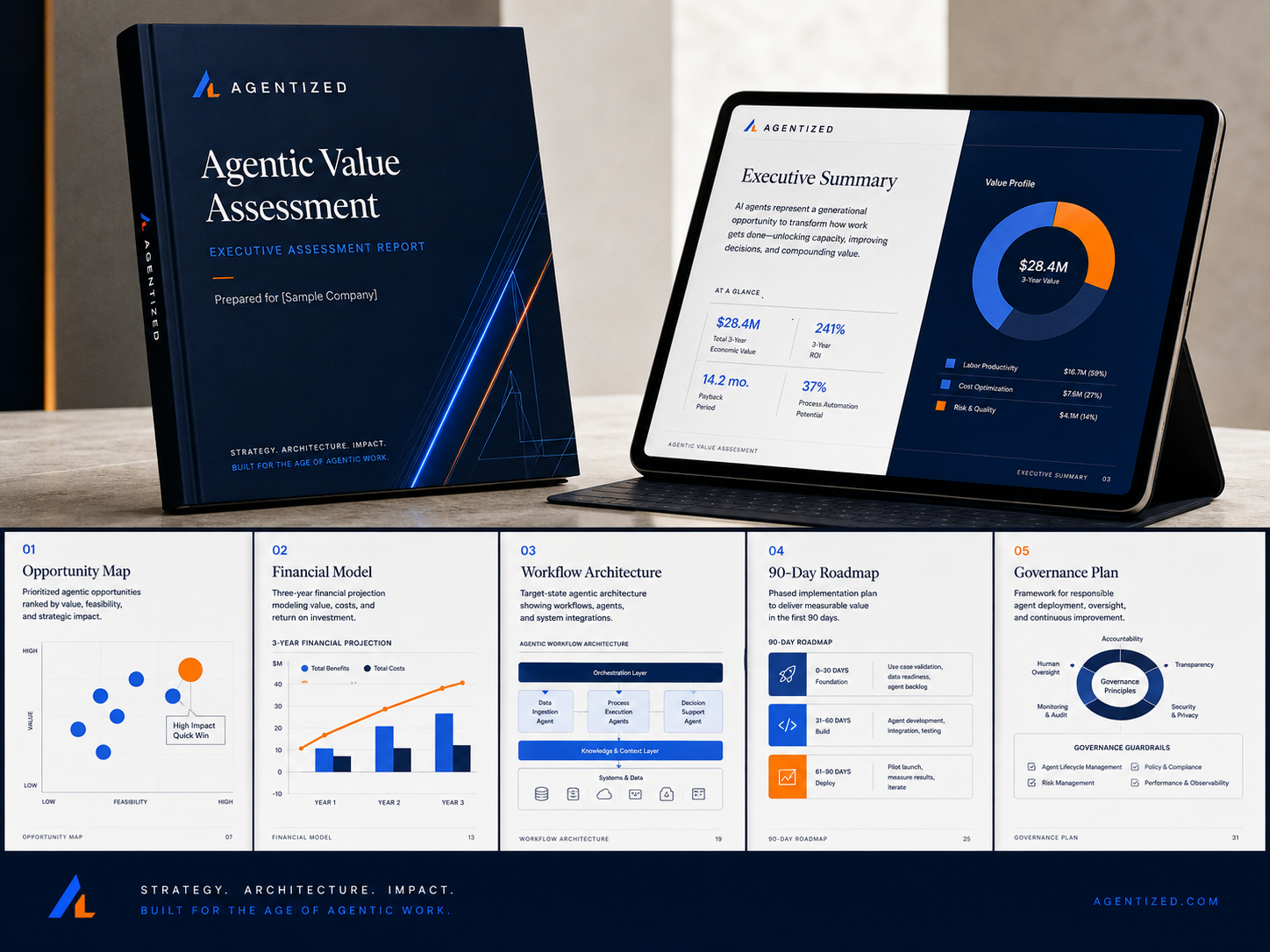
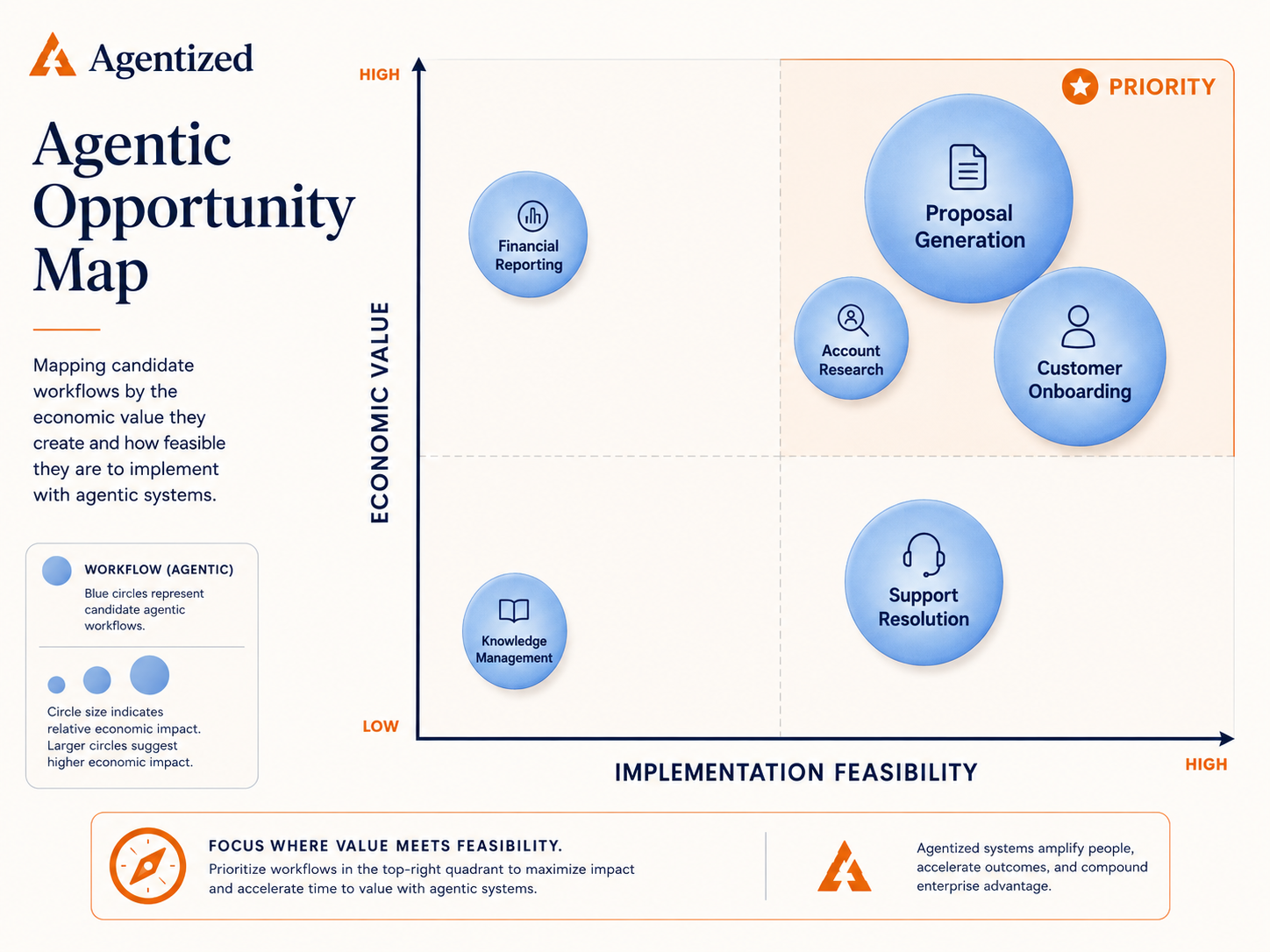
Sample deliverable: an Agentic Opportunity Map plotting candidate workflows by economic value and implementation feasibility, with priority workflows in the top-right quadrant. Sample deliverable: an Agentic Value Assessment executive report, prepared for a sample company, including an opportunity map, financial model, workflow architecture, 90-day roadmap and governance plan.

Illustrative samples. Prepared for [Sample Company].

Proof before scale

Measurable value, documented honestly.

Every engagement begins with a baseline, defines the cost of the new operating model and separates expected value from realized value.

How we document a result

What a case study will contain, once one is verified.

01
Client and contextNamed client, industry, company size and business owner.
02
Original processSteps, systems, people, handoffs and failure points.
03
BaselineAbsolute starting measures and measurement period.
04
Agentic designWhat agents did, what people retained and where approval occurred.
05
ImplementationSystems, data, time to production and adoption work.
06
ResultAbsolute and percentage outcome with cost included.
07
Quality and riskAccuracy, exceptions, rework, incidents and customer impact.
08
Executive evidenceNamed quote or approved statement from the accountable owner.
The standard

We report measured impact, not estimates.

Every Agentized engagement begins with a baseline and ends with an evidence review. We measure revenue, margin, capacity, speed, quality and adoption, then compare what we projected against what actually happened.

A projection is not a result. It becomes one only when it shows up in your operating numbers and your financials.

No case studies are published yet.

We won't fill this page with anonymous testimonials or invented metrics while we wait. When a client-approved result exists, it will be published here with a named client, a baseline and a verified outcome.

Review the Agentized Value System
FAQ

Agentic AI consulting questions, answered.

What does Agentized do?

Agentized helps mid-market companies redesign high-value revenue and operating workflows around governed AI agents. It combines strategy, workflow redesign, implementation, governance and change management to move agentic systems from executive priority to production.

How does an Agentized engagement start?

Agentized engagements begin with a paid Agentic Value Assessment, which takes four to six weeks. Each offer leads to the next.

What engagements does Agentized offer?

Agentic Value Assessment (4–6 weeks); 90-Day Agentic Value Pilot (12–14 weeks, one to three production workflows); Enterprise Agentization Program (6–18 months); Managed Agentic Operations (12-month minimum); and annual Board and CEO Advisory.

What is the Agentized Value System?

The Agentized Value System is five steps from a business opportunity to an agent running in production: Diagnose, Redesign, Deploy, Prove and Scale.

How does Agentized measure the value of AI agents?

Every engagement is measured against six questions: did it generate or protect revenue, reduce the cost of producing the outcome, increase throughput or capacity, compress cycle time, maintain or improve quality, and get adopted by employees and customers.

Why do most AI programs stall?

Most AI programs do not fail because the model is weak. They stall because the company selected a low-value task, preserved a broken workflow, ignored integration, never established a financial baseline, failed to assign an owner or treated governance and adoption as work to complete later.

How do I choose an AI consulting firm as a mid-size company?

Start with one manual internal workflow, set a measurable baseline, and choose the firm that can integrate with your existing systems and gives a scoped price. Agentized compares AI consulting firms for mid-size companies in Best AI Consulting Firms for Mid-Size Companies.

How do you implement AI in a mid-size company's operations?

Pick one high-value operational workflow, set a financial baseline, rebuild the workflow around human judgment and agent execution, then deploy and measure it. Agentized does this through a 4–6 week Agentic Value Assessment followed by a 12–14 week pilot. See AI consulting for mid-size companies.

Is Agentized a fit for small businesses?

Yes, if the business has roughly $1 million or more in revenue and a defined revenue, cost, capacity or speed problem. Businesses below that can start with free help from SCORE and their local Small Business Development Center. Agentized's small business guide compares other options.

How much does AI implementation cost for a mid-size company?

The Agentic Value Assessment is a paid engagement, not a free AI audit. Pricing for the assessment and pilot is on request.

Does Agentized work with our existing systems?

Yes. Agents are built, configured, integrated and evaluated in a controlled production environment connected to your existing systems and data.

Who founded Agentized?

Jas Dhillon and Mark Fidelman, authors of the upcoming book AGENT SHOCK: Surviving and Profiting from the Rise of AI Agents and Robots.
Ready to find the economic case?